• Home
  • Collage Workshops
  • Artists
  • Thoughts
  • About Us
  • Screening Room
  • Exhibits
  • Contact

  • Genesis Gallery
  • Up North Gallery
  • Collage Gallery
  • Library
  • Ascending Gallery
  • Photographic Gallery
  • Drawing Room
  • Dark Room
  • Studio
  • Books

  • Daily Art Blog
Gallery Arcturus *

Ramona Zoladek

July 5, 2025 by

http://ramonazoladek.tumblr.com/

My practice explores the relationship between nature, architecture and objects. It revolves around ideas of growth and ruin and the history exposed by these objects as they interact with nature. The tension between solid building materials and organic matter is obvious and naive but at the same time fascinating. I pay particular attention to those prominent features of the landscape which are supposed to be familiar but are not easily recognisable. These are often parts of buildings once were constructed for the purpose of habitation, they are now abandoned places, overgrown by nature; crumbling, decaying, becoming part of the landscape. As a result, they lose their function and therefore change their meaning.

The choice of materials and processes I use refer to my personal experiences and memories of growing up in Poland. My physical journey to the places and research into history is essential and it drives my practice. I depict landscape in my sculptures by physically applying soil and clay within my work and compose with plaster, paint and often organic materials and seeds to create new objects which have their own life. The unusual combination of those materials leads to other processes such as shrinking, expansion, growth and decay.

I repetitively use the form of plinths to shape casts used in my work. Through this traditional sculptural process I formalise the combination of plaster and seeds which then become part of the gallery space. I ‘destroy’ these forms and materials associated with traditional sculpture, by spraying them with paint and plaster and then reconstructing into different forms.

Time, process and material are particularly important aspects of my work. Each piece I construct demands structured planning and a dedicated set-up of its individual environment. However, even though I try to control this, there is always an element of unpredictability that emerges. The pieces I construct often appear vulnerable, as though they are about to collapse or fall apart.

I often create my work from a reflection on the different architectural forms found within a particular place. The narratives surrounding these places are not obviously reflected in my new work, rather they are suggested by symbolic elements that are translated from one to another.

2014
Pamela Williams

July 5, 2025 by

No biography is available at this time for Pamela Williams.

http://pages.interlog.com/~romantic/home.html

Dan Walsh

July 5, 2025 by

Content coming soon

Francine Vernac

July 5, 2025 by

FRANCINE VERNAC is a multidisciplinary artist from Quebec City. Her work as a painter is rooted in her desire to espouse a unique path to contemplate the world while escaping its veils. A strong yet sensitive quest of the absolute exploring intertwined textures, a spontaneous act of rhythm from which the artist shatters space and lets light narrates its own tale.

In addition, Francine studied the ancient art of calligraphy and several techniques used in art prints.

For the past twenty years, Vernac’s work has been shown throughout Canada, France, Belgium, Germany, Great Britain, Mexico and Tunisia as well as in the United States. She has been invited to various art exhibits throughout the world.

She has illustrated numerous books and her paintings are held by private and public collectors. She is a member of RAAV (visual art artists from Quebec), of Les Ateliers Ouverts (access to artists workshops yearly event) and a member of l’Union des artistes (an actor’s guild). She sits as a jury for established artists contests and prizes.

http://francinevernac.blogspot.com/

Susan Valyi

July 5, 2025 by

“As a sculptor I am interested in the creation of new forms and the three dimensional, tactile pleasure of a finished work. I like exploring unconventional materials. My work is mostly figurative with a mix of human and animal form. I would say what pleases me most is the exploration of gesture and pose but then I will turn around and cannibalize a chair to make a temple.

My work starts with collecting. I’m currently working mostly with old chairs and furniture that is beyond repair and has been discarded by the side of the road. Or begged from friends. Some of my sculpture take to complete so where the discard was pretty instantaneous, the rescue and transformation is long and involved. More than anything, the disassembling and reassembling satisfies my soul. I think it’s probably a very personal gratification. I’m addicted to process even at the risk that a piece doesn’t work out. My materials are unforgiving in that I can’t reshape easily but that’s where the excitement lies. In not knowing how something will turn out. Each piece is different. There’s always a challenge.

My sculptural process is one of addition, rather than subtraction. I build up forms by adding and then I grind away. It’s a continuous, long and messy process that was born of an accident years ago.

I work from my sketches. I certainly leave room for accidents to happen in the studio but I like the sketching. I like to have a good idea where I’m going before I start a piece. I like working with old wood which already has it’s stories to tell. I sometimes find the most interesting inscriptions on the undersides of old chairs. One of the chairs I cut up had ‘Mammy’s chair 1945’ scrawled under the seat. The wood is old seasoned and always surprisingly rich when I add a finish of tung oil. It’s a challenge to make shomething out of nothing. I believe artists are guided in part by their materials.

I studied at the Nova Scotia College of Art and Design and though I have joked that it has taken me thirty-odd years to recover from the experience, there is only a bit of truth to it. I think all the experiences we have as artists give us context and experience, although somewhere along the line I discovered the truth that I work alone in more ways than one. My art experience is solitary in terms of exchange but I continuously study art in a very pop culture kind of way. I devour art magazines and go to galleries whenever I can.

I don’t know what kind of art I make. I work on a more emotional level and a base one at that. Sometimes my work makes me laugh. Sometimes it’s the post that make the humour.

I’ve been asked to give lectures on humour in art and I’m quite fascinated with the subject. It’s not something you can plan. And it’s contrary to the perception that art has to be serious to be taken seriously. I work until I please myself and if I have an audience, all the better. Audience for me is very important. I’m interested in uncomplicated art that doesn’t need a lot of explanation to understand.

I live for the times when a new idea is born. It’s exciting. I’m also happy when the kinks in a piece have been worked out and I can just indulge in the process. I rented an old wood working shop this winter to accommodate much bigger pieces. As I go along I find myself surrounded by these creatures as they evolve and take shape. It’s like a room full of inanimate company. I like it. You can visit my Facebook page to see the work in progress.

I was born in Vancouver, British Columbia and for a great part of my life I move frequently until settling near a small French town, St. Eugene, Ontario on the Quebec border. If that’s not confusing.”

http://www.susanvalyi.com/works.html

http://www.susanvalyi.com/works.html

Heather Valencia

July 5, 2025 by

From: WAKING DREAMS

Heather Valencia

July 16 – August 31, 1996

In the ancient myths of her people, the goddess dreamed the world and it was. For many years a leader of the Yaqui dreaming circles, Heather Valencia reaches into the depths where myth is a reality and the life we lead is the dream from which we waken.

R.C. Trice

July 5, 2025 by

R.C. TRICE was born in Vancouver in 1957. He is a painter, sculptor, actor, puppeteer, musician, art conservator and picture framer. His work ranges from haunting and shadowy canvases to his highly original series Bag People, character portraits on ordinary brown paper bags, now available in ceramics as well. His work rests upon a lifetime of studying classical European and Oriental traditions. Robbert’s works have recently been exhibited in Vancouver, New York, Chicago, Sacramento, Philadelphia, Los Angeles, San Francisco and Toronto. He also serves as the President of Heidelberg Editions International, the corporate name used by the artists of The School of Reductionism.

http://gvgg.com/artists/trice/

Adrian Symonds

July 5, 2025 by

From 2014:

In the late ‘90’s I sculpted wooden body prayers in an attempt to experience the attributes of the Divine. The body prayers were based on the invocational postures as described in the work of E. J. Gold.

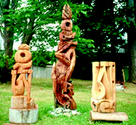
In 2000, I moved to the northwest coast of Canada and discovered a veritable treasure trove of driftwood. I abandoned my chisels, bought a chainsaw, and started pulling logs off the beach. My interest in Tibetan meditation found me carving Buddhist Seed Syllables from the mantra Oh-Ah-Hung and Om Mani Padme Hum. The three sculptures below are, from foreground to background, OM-Ah and Hung.

download

Since 1993, I have focused upon the art of body movement. I love doing push hands, the martial aspect of tai chi. It’s a great mechanism to explore balance, power, sensitivity and to experience the diverse variety of subtle intents that working with a partner can offer. It’s sort of like a mixture of personality psychotherapy reflected in movement and ballroom dancing… with the intention of knocking your partner flat on their back… with a smile of course.

Paul Saari

July 5, 2025 by

Paul writes of his work: “It is often the case that we forget we are as much a part of nature as the earth under our feet; on which we by no means tread lightly. In this latest series of work I have been interested in our relationship with the natural world. The human footprint – our ingenuity, our psyche, and our actions – is represented here by houses reduced to an archetypical form and re-contextualized as patterns in nature.”

http://www.paulsaari.com/

Kelly Rivera

July 5, 2025 by

Born in Puerto Rico, she studied art and theatre at the University of Maryland and then move to New York City where she worked professionally in both mediums. Rivera considers Rico Lebrun, Tom Johnson and E.J. Gold as having had the greatest influence on her work. She also has been inspired by tantric art in its use of colour and stylization. In her most recent works, we can see references to the symbolist and Pre-Raphaelite imagery of Dante Gabriel Rossetti. She uses art as a “means to access a world that is usually unseen”. Many of Rivera’s works are influenced by her vivid dreams, past and present. She has been a member of the School of Reductionism for 12 years.

SCHOOL OF REDUCTIONISM

Conceived in 1987 by E.J. Gold, a prominent American artist, and other members of the Grass Valley Graphics Group, an artists’ community in northern California. The School consists of more than 20 American and Canadian painters and sculptors who have worked with Gold to reformulate the aims and principles of contemporary visual art.

Reductionism embodies both a philosophy of art and certain practical principles which infuse its works with recognizable qualities.

The philosophy of Reductionism places utmost value on the creative act which originates as an aesthetic perception and a corresponding state or condition of being. It is then the artist’s task to capture or express this perception in a work of art which enables the viewer to have the same experience. Reductionist art is therefore objective in nature and not an exploration of the subjective states of the artist.

Artists of the School include: E.J. Gold, Della Heywood, Kelly Rivera, Heather Valencia, Stephanie Boyd, Menlo Macfarlane, Robbert Trice, Tom X., Claude Needham, Zoe Alowan, Richard Hart, Mark Einert, Douglass-Truth, Yanesh, Lidy Nova, Joe Alowan, Tim Elston, David Christie and more.

Although Reductionism in practice is broadly inclusive, experimental and evolving, its art is nonetheless often characterized by three basic qualities:

Essentialism

Reductionism uses recognizable objects and is therefore representational. However, objects are important for their effect, not important in themselves. The artist attempts to achieve an effect with the fewest possible lines and details, removing extraneous elements which may deviate or obscure the effect…thus the name Reductionism. Objects are reduced to their essentials in a move toward the abstract. Similarly, colour is used unambiguously and powerfully to enhance its effect. Colours are few, vibrant, sharply contrasting.

Timelessness

Reductionism typically explores another dimension of time, a dimension which is not sequential or “horizontal” but eternal or “vertical”…the same dimension of time which contains the creative act itself. There is little or no explicit movement in Reductionist art. Nothing is happening in the usual sense and time, therefore, does not pass. The result is an enhanced awareness of posture, positioning of visual elements and their inter-relationships. Freezing the frame, rendering objects static, also has the effect of freeing other forms of movement such as feeling…motion through emotion.

Space

Perhaps the outstanding feature of Reductionist art is that, despite a limited use of the techniques of perspective to create three dimensional effects within the picture, the art nonetheless establishes a sense of space. The reason is the primary place assigned to the viewer. Because the Reductionist artist strives for communication, scenes are composed for a viewer who is not a voyeur outside the scene but rather a participant who is the reason for the work and necessarily a part of it. Everything in the scene is oriented first and foremost to the viewer so as to bring the viewer into a relationship with it. Depth of field is therefore not bounded by the frame but includes the viewer in a truly three dimensional experience of space. Thus, the art is only completed by viewing.

http://www.anessentialartist.com/

  • 1
  • 2
  • 3
  • …
  • 6
  • Next Page »

Recent Posts

    Recent Comments

    No comments to show.